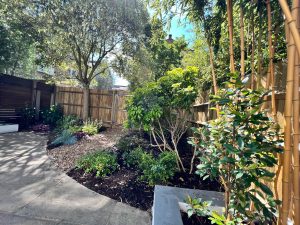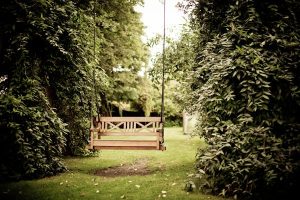

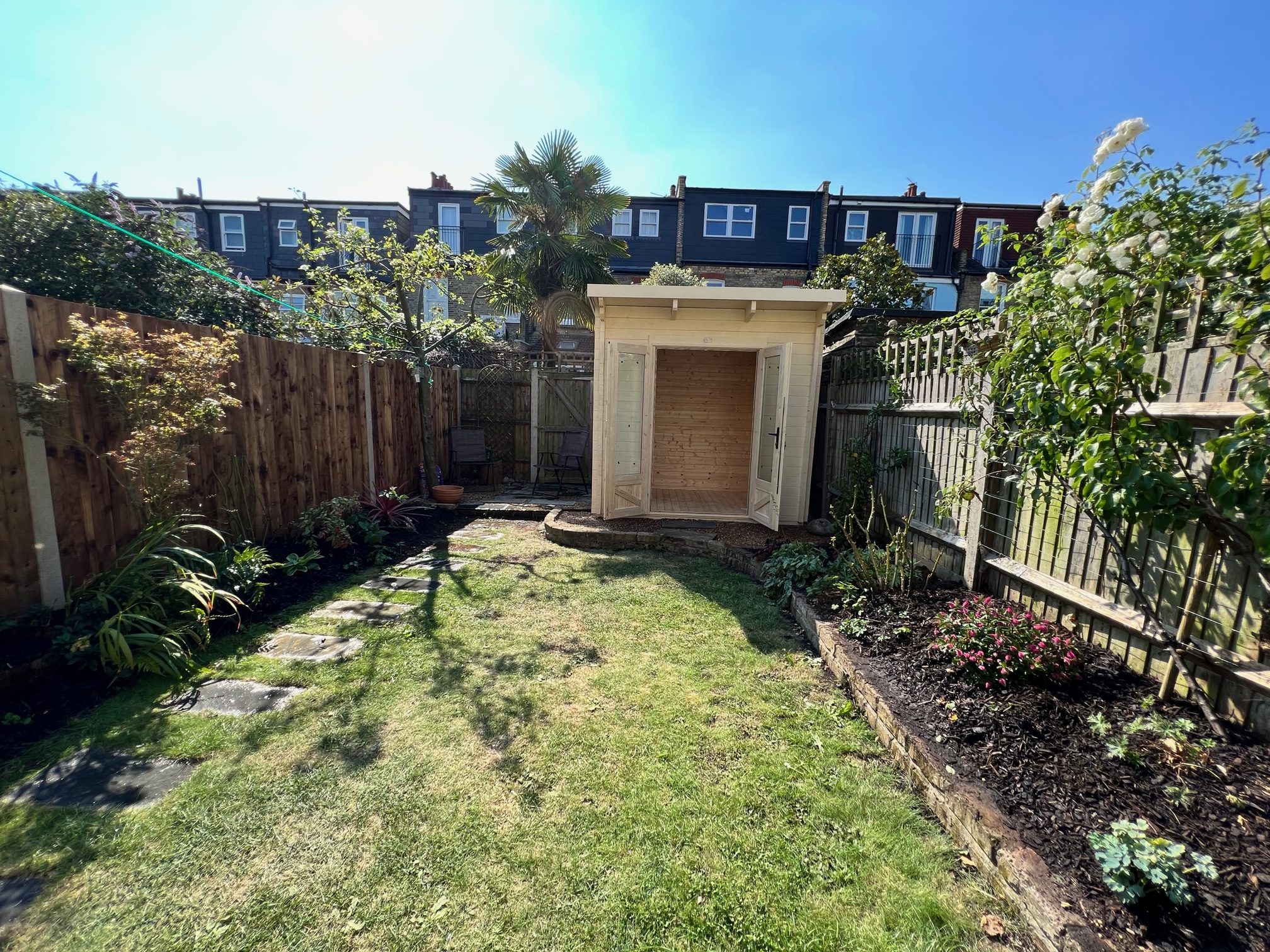
Most London gardens are small. Not cottage small, not courtyard small necessarily, just the kind of space that makes you realise why estate agents start using the word “manageable” in their listings. A narrow strip behind a Victorian terrace in Wandsworth. A side return tacked onto a Putney flat. A squeezed rectangle between two semis in Teddington. That’s what we’re usually dealing with.
And people still want everything from it. Somewhere to eat outside on a warm evening. A patch the kids won’t destroy in a week. A place that doesn’t feel like you’ve walked into a gap between two houses. Fair enough, really. Why should a small garden do less than a big one?
Here’s the thing, though. Small gardens often end up better than large ones, and we’ve built enough of both to say that with a straight face. You can’t hide bad choices behind a lawn. There’s no deep border to lose a mistake in. Every square foot has to do something, which sounds limiting until you realise it’s actually a gift. It forces you to think.
That’s where the hard landscaping comes in. The paving, the walls, the steps, the fencing, whatever’s holding the space together. When those bones are right, a garden barely larger than a decent kitchen can feel like an actual room you want to be in. Get them wrong and no amount of planting will save you.
What hard landscaping actually does in a small garden
Out in a big garden, hard landscaping is one layer of many. A path here, a patio there, a wall at the back fence. In a small garden, it’s pretty much everything you look at. The ground under your feet, the boundaries on three sides, the levels, the built-in bits. Planting fills around it. The structure goes first.
Why does this matter more at this scale? Because the garden is right there. A patio with a slightly off fall drains into your back door, and you notice every time it rains. A fence that fights the brickwork of your house has nowhere to hide when you can see the whole thing from the kitchen window. A clumsy step change that’d disappear in a bigger plot becomes the thing your eye can’t stop catching on.
Which is why we keep banging on about groundwork. It’s boring, nobody sees it, and it’s where the job is won or lost.
Making a small London garden feel bigger than it is
Half of this is perception. The plot is what it is; you can measure it with a tape, but how it reads is another matter entirely. A few moves, done with a bit of care, can shift that reading.
Paving patterns and direction
The way you lay paving changes the shape of the garden before you’ve put a single plant in. Run slabs across the width, and the space looks shorter and wider. Run them along the length, and the eye gets pulled to the back fence, which makes things feel deeper. Go diagonal, and the gaze tracks from corner to corner, which in most rectangular London plots is the longest line you’ve got to work with.
Light and reflective surfaces
Dark paving eats light. In a north-facing back garden hemmed in by neighbouring walls, which is a fair chunk of London housing, that’s the opposite of what you want. Go pale. Buff sandstone, silver grey granite, off-white porcelain, they all bounce daylight back into the space and lift the whole feel of the garden, especially on the grey days we get most of the year.
Worth thinking about your fencing colour too, while we’re here. A stained cedar or a soft limewashed timber throws light around in a way that the standard orangey brown larch lap panel never will.
Big paving slabs beat small ones
Small slabs mean lots of joints. Lots of joints mean lots of lines for your eye to trip over, and in a small space, that starts to feel fussy pretty quickly. Go large format. A handful of properly sized porcelain slabs across a patio looks calmer, more considered, and oddly more generous than twice as many smaller ones covering the same area.
There’s a maintenance angle as well. Fewer joints means fewer gaps for moss and weeds to get established in, which saves you a weekend with the pressure washer every spring.

Going up when you can’t go out
When the footprint won’t grow, the walls will. Most small gardens actually have more vertical surface than horizontal once you start counting fences, boundary walls and the flank of the house itself. That’s usable territory if you want it to be.
Raised beds along the edges
Raised beds earn their keep in a few different ways at once. They lift your planting off the ground and closer to eye level, which pulls you into the garden rather than leaving you looking across it. They give plants deeper soil, which is no small thing in London, where most of what’s underneath you is compacted clay, broken brick from some extension in 1952, and whatever the last owner buried down there. And if you build them with a generous top edge, that edge does duty as extra seating when you’ve got people around.
Climbers, trellises, green walls
Stick a trellis on a fence, plant a star jasmine or a well-behaved climbing hydrangea up it, and you’ve added maybe a metre and a half of living height without giving up any floor. That’s a straightforward win. Living wall systems take the idea further, turning a blank wall into a planted surface with irrigation built in, though they’re a bigger commitment both in money and in looking after them. In a courtyard with one dominant wall staring at you, they can be the thing that completely changes the space.
Pergolas
A pergola does something you wouldn’t necessarily expect in a small garden. By adding a kind of ceiling over part of it, the space feels more defined, and here’s the odd bit, it actually feels larger rather than smaller. The eye lifts. You get a proper sense of enclosure over the dining spot without losing any ground-level area. Slatted oak works nicely. Powder-coated steel is good if the house leans modern. Just don’t go too chunky with the timbers, because heavy sections eat a small garden alive.
Zoning, or dividing to conquer
You’d think dividing a small garden would make it feel smaller. It’s the instinct almost everyone starts with: keep it open, leave it as one piece. In practice, that rarely works. An undivided rectangle reads as exactly what it is, a rectangle. Break it into two or three zones, and suddenly there’s more to take in, the eye has to move around, and the space feels bigger because it takes longer to read.
Making garden rooms
Even in a plot barely bigger than a good-sized living room, you can fit a dining zone near the back of the house, somewhere softer and more planted further down, and maybe a working corner for bins and bikes tucked behind a screen. You don’t need walls between them. A change in surface underfoot, a low hedge, a single step up of a few inches. Any of these signals to the brain that you’re in a different area.
Letting materials do the zoning
Changing the surface is one of the cleanest ways to mark out different areas without building anything. Porcelain under the table and chairs, gravel or stepping stones through a planted section, and a raised timber deck at the back for lounging. You’ve got three surfaces doing three different jobs, and the garden reads as having shape to it. Just make the transitions look intentional. A clean metal edge, or a row of bricks laid on their sides, turns a potentially messy boundary between materials into a feature.
This is where we see a lot of small gardens go wrong. Someone’s been told a single material will make the space feel bigger, and they’ve run the same slab everywhere. The garden ends up feeling flatter, not larger. Variety, done carefully, does the opposite.
Features that pull their weight
A few well-chosen additions will punch above their size. These are the ones we come back to most.
Mirrors
A garden mirror fixed to a back wall or a fence, framed so it looks like a window or a gate through to somewhere else, is an old trick and still a good one. It doubles the apparent depth and throws light into the shaded corners that every London garden seems to have. The trick is in the angle. Tilt it slightly so it reflects planting rather than you walking towards it, and tuck the edges behind a climber so the frame disappears. Suddenly, there’s another garden through there.
A focal point worth looking at
Without something to anchor the view, a small garden can feel scattered. Bits of this and that with nowhere for the eye to rest. A focal point fixes this. It could be a sculptural pot. A small multistem tree, something like an Amelanchier or a Cornus kousa that stays mannerly in a tight space. A water feature against the back wall. Anything, really, that gives the gaze somewhere to end up when it travels down the garden.
Making one thing do two jobs
Anything in a small garden that only does one job is probably taking up space that could be working harder. The best small garden designs stack functions wherever they can.
Built in seating
Fixed bench seating built along a boundary wall gets you more seats per square foot than any combination of chairs and tables. A run of built in bench along the back, topped with cedar slats, sits four or five people without breaking a sweat. Takes up hardly any depth. And because it doesn’t move, it’s still there on the wet weeks when loose chairs would have been dragged into the shed. Cushions come out when you want them. They go away when you don’t.
While you’re building the bench, hollow out the underneath for storage. Now it’s seating and it’s hiding your cushions, gardening tools, and more.
Storage hidden in the structure
Retaining walls can hide storage. A raised bed can have a lid over part of it for firewood. The side return bench can swallow the bins until collection day. None of this shows in the finished garden, which is the whole point. You get the storage without the garden looking like it’s got storage.
Retaining walls also turn into seating pretty easily if you top them with a wide coping, and that’s the kind of thing worth deciding on at the design stage rather than trying to bodge in afterwards.

The material question
Material choice matters more in a small garden because everything’s in close view. Cheap slabs have nowhere to hide. Here’s how the main options shake out for London conditions, though none of this is rocket science and you should always look at samples in person.
Porcelain is where we end up on most jobs. It’s dense, so water barely touches it. Moss struggles to get a grip, stains don’t really take hold, and it shrugs off the freeze thaw cycles that can lift some natural stones over a few winters. It comes in big formats, which is exactly what a small garden wants. And the colour range runs from almost white limestone looks through to proper dark basalt tones. The catch? It needs a proper mortar bed and someone who knows what they’re doing with the cuts. Laid badly it’s worse than concrete. Laid well it still looks the same in a decade and a half.
Gravel gets overlooked more than it should. Cheap, permeable (which matters for drainage rules on front gardens, by the way), and it gives you a sound underfoot that paving can’t match. The crunch is half the pleasure. Put a steel edge around it, a decent weed membrane and compacted base underneath, and it reads as deliberate rather than leftover. We use it in planted zones, on pathways between stepping stones, as a surround where a hard surface would be overkill. Just steer clear of the pale pea shingle that ends up in every shoe and indoors on the kitchen floor.
Composite decking is miles better than it used to be. The early versions looked plasticky and faded to a weird grey. Current quality products (the mid to upper end, not the bargain stuff) give you a convincing timber grain that lasts for many years with almost no upkeep, which in a small garden where you’re looking at the deck from two metres away is worth a lot. No sanding every spring. No oiling. It’s also warmer underfoot than stone, which if you’ve got kids or like walking out barefoot in the morning is a real quality of life thing.
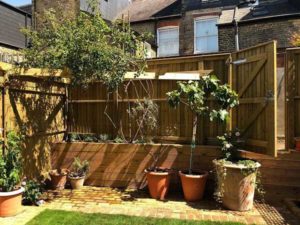
Cedar fencing changes the whole garden, not just the boundary. Fencing is half of what you’re looking at in a small plot, so spending properly on it makes sense. Western red cedar, left to weather to a silver grey or stained a dark charcoal, shifts a fence from background annoyance to something you actually want to look at. Horizontal slatted cedar panels in particular suit most London houses, whether you’re in a Victorian terrace, an Edwardian semi or something more recent. It costs more than treated softwood, no getting around that. But it lasts far longer, doesn’t warp the same way, and looks right from day one rather than needing three years to settle in.
Bringing it all together
A small London garden isn’t a compromise. Some of the best gardens we’ve built have been the tightest ones, because the space forces you to make real decisions instead of hiding behind scale. When you can’t afford a wasted metre, everything ends up meaning something.
If you’ve got a small plot anywhere in Wandsworth, Putney, Richmond, Twickenham or the surrounding SW postcodes, we’re happy to come and walk it with you. An hour on site tells us more than any amount of photos or sketches. From there, we can put a plan together that gets more out of the garden without making it feel cluttered, and build it in a way that still looks right when you’ve lived with it for a while.
Small doesn’t have to mean less. In the right hands, it ends up meaning more.