
Most gardens fail not because someone chose the wrong paving stone or the wrong plant, but because nobody decided how the two should sit together before either one went in. You end up with a patio stranded in the middle of a lawn, or a border so wide it swallows the space you actually wanted to sit in. Getting hard and soft landscaping to work as one design, rather than two decisions made months apart, is the difference between a garden that photographs well on day one and one you still love using five years later.
In London, this matters more than it might elsewhere. Terraced plots are narrow, soil is often heavy clay that drains badly, and most gardens need to do several jobs at once, entertaining space, somewhere for children to play, a bit of green that doesn’t demand a weekend a month to maintain. There’s no template that solves all of that, but there is a way of thinking about balance that makes the decision far easier, and it starts with clay, drainage, and gardens too narrow to waste an inch of.
What Is the Ideal Hardscape to Softscape Ratio?
There isn’t a single correct ratio, whatever a generic design guide might promise. The right split depends on how you use your garden, how big it is, and how much time you’re realistically willing to spend maintaining it. Three broad approaches cover most gardens we work on. The entertainer’s garden runs closer to 60:40 in favour of hard surfacing, patio, decking, maybe a built-in kitchen, with planting used to frame rather than dominate. The balanced garden sits nearer 50:50, giving equal weight to seating and a proper planting scheme, which suits families wanting play and relaxation without leaning hard either way. The nature-lover’s garden flips it to roughly 30:70 in favour of planting, with hard surfacing reduced to a path and a small seating spot, and the rest handed over to borders and wildlife.
Garden size changes the maths too. A small SW London terrace often needs more hard surfacing proportionally, since a tiny lawn patch reads as an afterthought rather than a feature, whereas generous paving with well-placed planting can feel deliberate even at modest scale. And be honest about maintenance. A 30:70 planting-heavy garden looks wonderful in a magazine and demands real, regular attention, weeding, pruning, deadheading, whereas more structured hard landscaping needs a fraction of the ongoing effort. Get garden design input early if you’re unsure, because this decision shapes almost everything that follows.
How Should You Zone a Garden?
Zoning means giving different sections of the garden a clear job, rather than letting the whole space try to do everything at once, which is usually what makes it feel cluttered and undecided.
The Social Zone
Patios, decking, and any outdoor kitchen belong wherever they’ll actually get used, which isn’t always the spot that looks best on a plan. Think about where the sun sits at the time of day you’re likely to be out there, and how close it needs to be to the kitchen door. A social zone positioned too far from the house often sits unused within a year, however good it looks. Paving and patio installation done properly accounts for drainage and levels here too, which matters more than people expect on London’s clay.
The Transition Zone
Between the social zone and the rest of the garden, you need a transition that connects the two without feeling like a corridor. This is where pathways earn their place, and where softer materials, gravel, planted edging, stepping stones set into planting, do more work than a straight run of paving ever will. Well-considered edging handles most of that job without needing much else.
The Living Zone
Beyond that sits the living zone, where the garden actually breathes, lawn or lawn alternative, flowerbeds, vegetable beds if you want them. This is usually the largest single area even in a hard-surfacing-heavy design, and getting the soil right here matters more than almost anything else in the whole project. Our soft landscaping team builds this stage on peat-free soil and works with rainwater irrigation wherever the site allows it, because a living zone that depends on constant intervention isn’t really doing its job.

How Do You Soften Hard Landscaping?
A garden made entirely of hard edges reads as cold, whatever the paving cost. Softening isn’t about hiding the hard landscaping, it’s about letting planting interrupt straight lines enough that the whole thing feels considered rather than assembled. Spilling border plants do more for this than almost anything else. Something like catmint, alchemilla, or a low, sprawling geranium planted right at a border’s edge will lean into the paving within a season or two, blurring what would otherwise be a hard right angle.
Height does a similar job in the opposite direction. A trellis with a climber or a wall-mounted planter brings green into the eyeline rather than only underfoot, which matters enormously in a small garden where there isn’t much ground plane to work with. If your garden is short on width but has decent wall height, vertical gardening is often the single most effective tool available.
Material choice softens a garden too. Permeable paving, whether that’s a specific porous product or simply gravel and jointed stone that lets water through, avoids the slightly stark look of a fully sealed patio while doing genuine environmental work. On London clay, where drainage is already a problem, this isn’t a nice-to-have. Water that soaks away through the paving is water that isn’t pooling against your house or running off into an already stretched drain.
Combining Hard and Soft Landscaping in a Small Garden
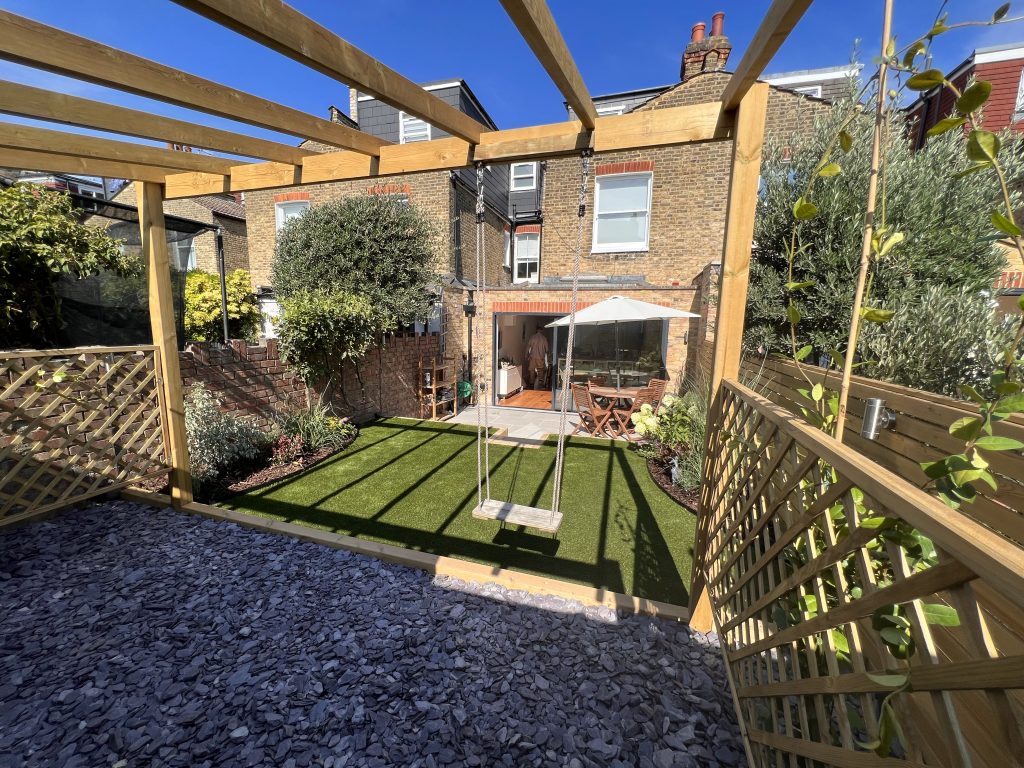
Small London gardens, the kind you get behind a typical Wandsworth or Earlsfield terrace, don’t have room for generous zoning, so hard and soft landscaping need to overlap rather than sit side by side. There’s real skill in making a small hard landscaping scheme work without it swallowing every inch of planting space.
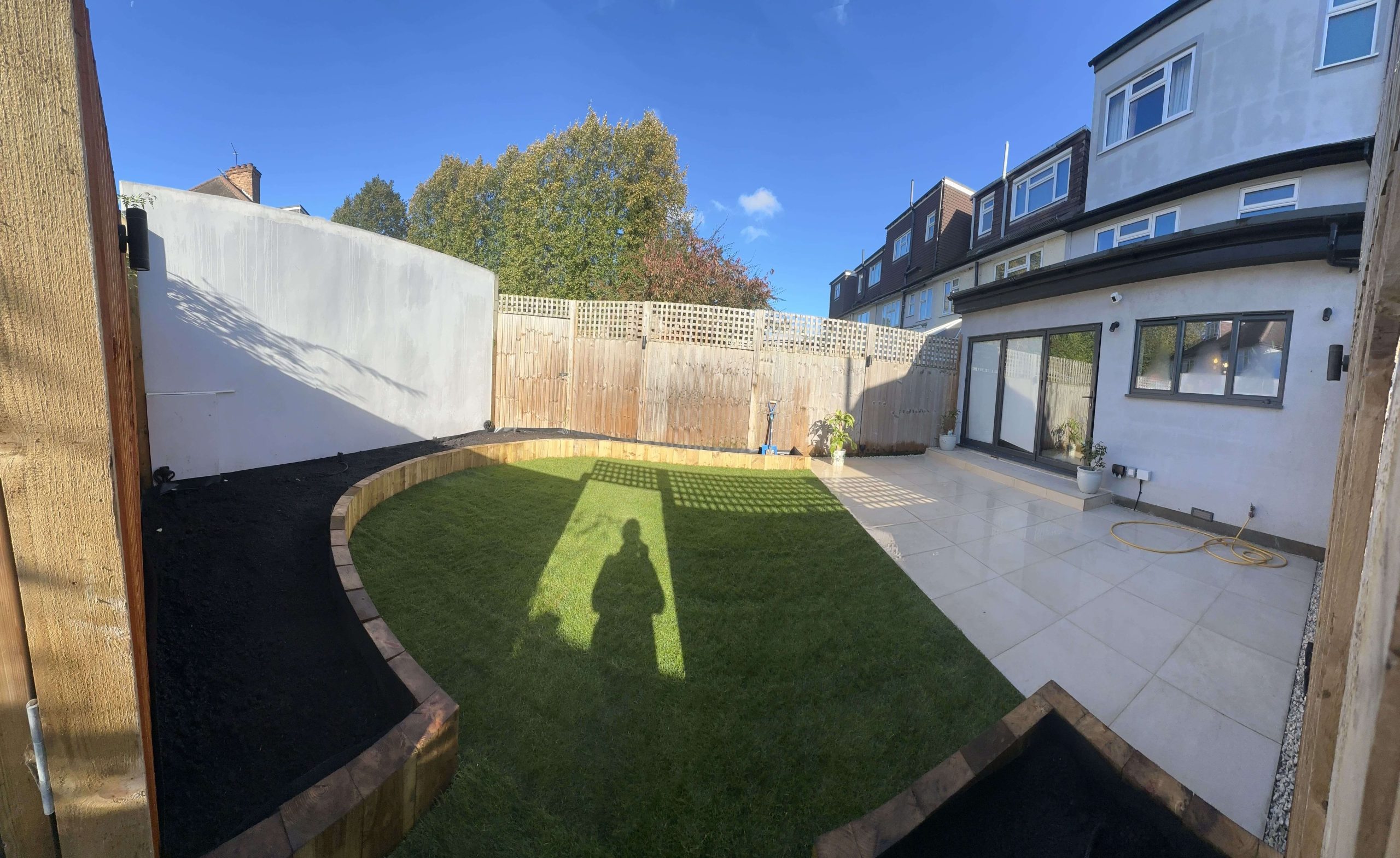
Raised beds do double duty, giving you a defined hard edge while solving the soil quality problem that plagues so many London back gardens, and the structure often doubles as extra seating. Rather than a continuous run of paving, leaving deliberate pockets for planting, a single specimen shrub, a cluster of grasses, breaks up what would otherwise be a slab of hard surface without sacrificing much usable space. Containers are the most flexible tool of all, costing little and committing to nothing permanent, while wall-trained climbers or a living wall panel let a tiny garden hold far more greenery than its footprint suggests once the ground plane is mostly given over to paving.
Planning, Clay, and Drainage
Sequencing matters as much as the individual decisions. Hard landscaping, paving, walls, raised beds, needs to go in before most planting, partly because deliveries and machinery damage soft landscaping already in the ground, and partly because the hard structure defines where planting actually has room. Our garden redesign process always follows this order for exactly that reason. Decide bed depth and boundary privacy early too, since retrofitting either around an already-finished patio is far more disruptive and expensive than getting it right from the start.
London clay is the single biggest technical challenge in almost every garden we work on. It holds water badly in winter, cracks and bakes in summer, and compacts hard under foot traffic. Choosing permeable materials wherever you can gives rainwater somewhere to go rather than pooling on the surface. Where a garden holds water badly despite that, a French drain, a gravel-filled trench with a perforated pipe running to a soakaway, can move water away from problem areas without regrading the whole garden, and it’s worth reading up on managing excess rain before committing to one. Better still, drainage can be built into the planting itself. A shallow rain garden planted with moisture-tolerant species in the lowest point of the garden turns a problem into a feature, catching runoff while thriving on exactly the conditions the rest of the garden struggles with.
Softening Fences and Walls, and Improving Planting Conditions
Softening Fences and Walls
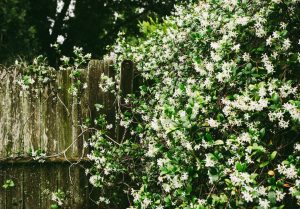
Boundaries are usually the largest continuous hard surface in a small garden, often larger than the patio itself, which makes them worth just as much attention. A timber trellis fixed to an existing fence gives climbers, clematis, jasmine, climbing roses, something to grip and immediately breaks up a flat panel, and a well-chosen fencing scheme designed with that in mind from the start ages far better than trellis bolted on afterwards. Where more coverage is wanted, a proper green wall system gives a dense wall of foliage, and there’s a good range of natural wall ideas worth looking through before deciding how far to take it. Layering shrubs, then perennials, then groundcover in front of a boundary also means it still looks good in winter, once deciduous climbers have dropped their leaves.
Using Hard Landscaping to Improve Growing Conditions
Hard landscaping can improve growing conditions rather than just constrain them. A raised bed built to sitting height gives planting proper soil depth, bypassing poor native clay entirely rather than trying to fix it in place. Leaving gaps between paving slabs for low groundcover, creeping thyme, chamomile, or moss in shadier spots, softens a hard surface while improving drainage. Changing levels within a garden, a raised bed here, a sunken seating area there, lets hard and soft work with each other rather than compete for the same flat plane, and a good deal of what we solve through hard landscaping comes down to exactly this kind of level change done well.
Matching Materials With Planting
Material choice sets the tone, and planting needs to work with it rather than fight it. Sleek, uniform materials like porcelain paving or smooth slate suit structured planting, hedging, grasses, sculptural specimens, which sits at odds with a loose cottage-garden mix. Our main hard landscaping work often pairs this material style with exactly that kind of restrained, contemporary planting. Natural stone with more colour variation, Indian sandstone or reclaimed Yorkstone, sits comfortably alongside herbaceous borders and roses instead, while timber decking or sleepers combined with gravel gives a garden a relaxed, rustic feel that works particularly well with naturalistic, wildlife-friendly planting.
Creating a Cohesive Design
The final piece is coherence. Repetition, using the same three or four plants in clusters throughout rather than a different specimen in every gap, gives the eye something familiar to follow and ties distant parts of the garden together. Limiting your material palette to two or three choices used consistently does the same job for the hard landscaping. Ultimately, the strongest gardens are the ones where hard and soft were never really separate decisions at all, where the same plan considered stone and planting together from the first sketch. Bolting one onto the other afterwards almost always shows.

Why The Southwest London Gardener Builds Hard and Soft Landscaping as One Project
We don’t split hard and soft landscaping into separate jobs handled by separate teams, and that’s deliberate. A patio designed without knowing what’s going in the border next to it tends to produce exactly the disjointed gardens this guide has been talking about avoiding.
Every project starts with the same site visit, assessing soil, drainage, sun exposure and access before a single material or plant gets specified. On the clay-heavy ground that dominates Wandsworth, Wimbledon, Putney and the rest of Southwest London, that groundwork decides almost everything that follows, whether a border needs raising, whether a French drain is worth the investment, which paving will actually stay level rather than heaving after a wet winter. We work with local nurseries and growers we’ve built relationships with over years, use peat-free soil throughout, and specify permeable materials wherever a garden’s drainage calls for it.
Conclusion
There’s no formula that tells you the exact ratio, zoning, or materials your garden needs, whatever a generic guide might promise. What actually works is understanding the principles, how ratio shifts with lifestyle, how zoning gives each part of the garden a job, how materials and planting need choosing together rather than separately, and then applying them to your own plot, soil, and the way you actually want to live outside.
London gardens carry their own particular challenges throughout. Clay soil that needs drainage thinking from the start, narrow plots that demand every hard surface earn its keep, and boundaries that matter more here than almost anywhere else. Get those fundamentals right, hard structure first, soil and drainage considered early, planting and materials chosen to work with each other rather than against, and the rest of the design tends to follow naturally. If you want an honest read on what your own garden can support, get in touch and we’ll talk you through it properly before anything gets specified.