
Every garden has its quirks. A slope that makes half the space unusable. A corner that stays boggy through winter no matter what you plant there. A terrace that bakes in summer and turns into a skating rink the moment frost arrives. Most people assume these are just features of the plot they have to live with, but in our experience working across South West London, the vast majority of them are solvable. Often more easily than people expect.
Hard landscaping gets talked about a lot in terms of aesthetics. New paving, a smarter patio, updated edging. And yes, it transforms how a garden looks. But the more interesting conversation, and the one we find ourselves having with clients again and again, is about how the right structural choices can fix the underlying problems that make a garden frustrating to use in the first place.
A garden that drains well, sits level where it needs to, gives you usable outdoor space in all seasons, and does not constantly fight against the natural conditions of the plot is worth far more than one that simply looks good in photographs. Getting there is mostly a question of understanding which problems respond to which solutions, and then doing that work properly from the ground up.
Poor Drainage and Waterlogged Ground
Why It Keeps Happening
This is the problem we hear about most. A lawn that stays soggy through winter, a patio that pools after every rain shower, a lower section of garden that effectively becomes a pond from November through to March. The culprit is almost always the same thing underneath all of it: London clay. It is dense, it does not drain freely, and when you lay paving or compact soil on top of it without thinking about where water is supposed to go, you create problems that only get more obvious as the years go on.
What Actually Fixes It
Good drainage design is not complicated in principle, though it does need to be thought through properly before any hard landscaping goes in. A patio with adequate fall, gentle enough that you would not notice it underfoot but consistent enough to channel water off the surface and away from the house, solves a remarkable number of ponding problems on its own. Pair that with a drainage channel or gulley at the lowest edge, running to a soakaway or connecting to a surface water drain, and you have dealt with the majority of what London clay does to a garden terrace.
For lawns and planted areas, French drains installed along the boundary or across the lower section of a garden can make a dramatic difference. These are not elaborate structures. A trench, a perforated pipe bedded in gravel, covered and returned to grade. But they redirect water that would otherwise sit on the surface and give it somewhere to go. In gardens where we have installed these alongside permeable paving or gravel paths, the change through a wet winter is stark.
Permeable paving is worth a specific mention here. Block paving and resin-bound gravel laid on a free-draining sub-base let water pass through the surface rather than run off it. In smaller London gardens where every square metre of hard surface matters, choosing permeable materials keeps water in the ground where planting can benefit from it and reduces the volume hitting your drainage system in one go.
Sloping and Uneven Ground
The Problem With Ignoring a Slope
A sloping garden sounds like a design opportunity, and it can be. But left unaddressed, a significant slope makes most of the garden practically unusable. Furniture does not sit level, children cannot play safely on a gradient, and every time it rains heavily, you get water sheeting down the slope toward the house or pooling at the base. We see this across a lot of south-west London gardens, particularly in areas like Wimbledon and Putney where plots often follow the natural contour of the land.
Terracing and Retaining Walls
The most effective solution for a sloped garden is terracing: breaking the slope into a series of level platforms retained by walls or sleepers, each usable in its own right. Done well, this does not just solve the practical problems. It creates genuinely interesting garden structure, gives you distinct zones for different uses, and makes the most of a plot that might otherwise feel awkward.
Retaining walls can be built from a range of materials. Natural stone gives a generous, established feel and beds into a planting-heavy garden beautifully. Brick suits a more formal setting. Timber sleepers work well in relaxed, naturalistic schemes and are particularly good at integrating raised planting beds into a terraced design. The choice of material matters less than the engineering behind the wall. A retaining structure that is taking real lateral pressure from soil and water needs to be built properly, with adequate footings, the right mortar or fixings, and drainage behind the wall so water does not build up and push against it.
Steps between levels are worth thinking carefully about, too. Wide, generous steps that feel like a natural part of the garden rather than a utility feature make terraced gardens much more enjoyable to move around in. Narrow steps tucked into a corner feel like an afterthought and tend to make the whole design feel cramped. If you are going to terrace a garden, do the steps properly.
Unusable Outdoor Space
When Your Garden Just Does Not Work
Some gardens are technically fine but practically useless. There is space, but nowhere comfortable to sit. There is a patio, but it catches the wind, gets no sun, or is too small to put a table on without blocking the back door. A garden that does not get used is a garden that does not give you anything back, which is a shame when the potential is there.
Creating Space That Works in Practice
The position of a seating area matters enormously, and it is something worth getting right before any paving goes in rather than after. A terrace that follows the sun rather than the shape of the house, that is sheltered from the prevailing wind, and that connects naturally to the kitchen or living space gets used through far more of the year than one that was positioned purely because it was the obvious spot behind the back door.
Size is another thing people often underestimate. A patio that feels generous when it is empty can feel cramped the moment you add a table, four chairs, and a couple of plant pots. Working out what you actually need the space to accommodate and then adding a bit more is always the right approach.
Defined paths and circulation routes are part of this, too. A garden where you are not quite sure where to walk, where the lawn gets worn in lines because there is no clear route from one part to another, can be transformed by a simple gravel or stepping stone path that gives people somewhere to put their feet. It sounds minor. In practice, it changes how a garden feels to be in completely. Have a look at some of the garden projects we have completed to see what a difference well-thought-through circulation makes to a space.
Difficult Surfaces and Problem Patches
The Spots That Never Seem to Work
Every garden has at least one. The shaded corner where nothing grows well and the ground stays damp. The strip along the side of the house that collects debris and looks unloved. The area under a large tree where the soil is dry, root-filled, and hostile to planting. These spots cause a disproportionate amount of frustration relative to their size.
When Hard Landscaping Is the Honest Answer
The temptation is always to try another plant. A different ground cover, something more shade-tolerant, something that might cope better this time. Sometimes that works. Quite often it does not, and the honest answer is that certain spots are simply better suited to hard landscaping than to planting.
A gravel garden under a tree, laid over a permeable membrane with a generous depth of aggregate, gives you a surface that looks good, requires almost no maintenance, and does not fight against the conditions the way planting does. A paved or decked area in a permanently shaded corner becomes a useful part of the garden rather than a problem to be solved every year. Side returns and awkward strips between buildings respond very well to a combination of hard surface and simple vertical planting, giving you a tidy, low-maintenance space from something that previously felt like dead ground.
The key in all of these cases is choosing materials that suit the conditions rather than working against them. Shade, moisture, root pressure. These are not problems to be hidden. They are site conditions to be designed around.

Lack of Privacy
The Overlooked Garden
A garden you cannot relax in because neighbours or passing traffic can see straight into it is a garden you will not use as much as you should. Privacy is one of the most common things people raise with us during initial conversations, and it is one of the most satisfying problems to solve because the difference it makes to how a garden feels is immediate and obvious.
Structural Solutions That Actually Work
Planting alone rarely solves a privacy problem quickly. It takes time to establish, it needs ongoing maintenance, and depending on where the oversight is coming from, it may not ever get tall enough to do the job properly. Structural solutions work faster and hold their ground without needing much from you.
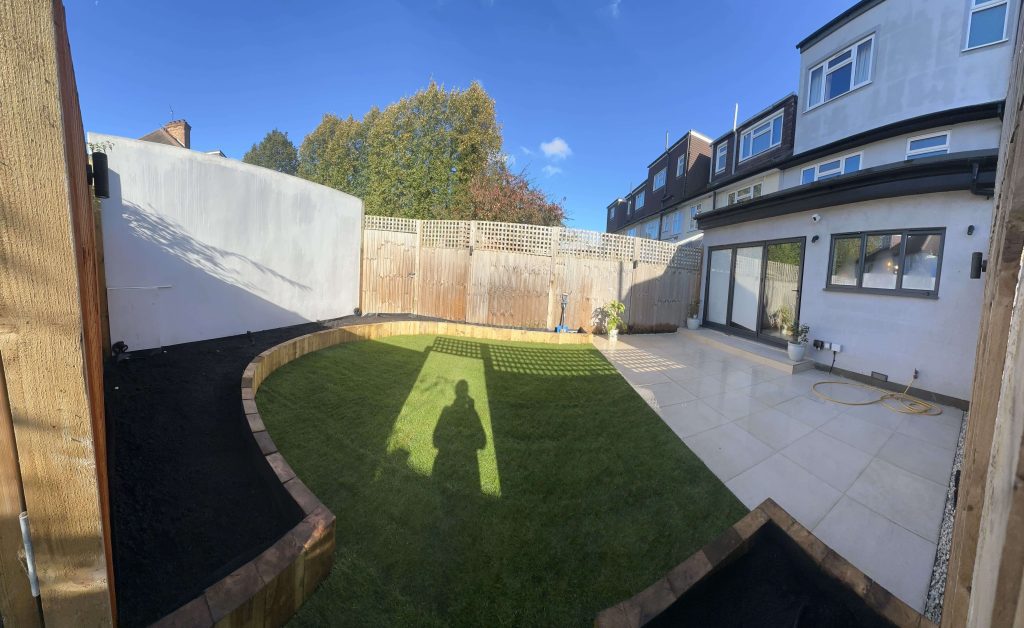
Raised sleeper planters along a boundary add height and give you a planting bed at the same time, which means you get both the structure and the greenery without waiting years for one to do the job of the other. A well-designed timber or brick boundary feature, built to a height that addresses where the overlooking actually comes from rather than just going as tall as planning allows, makes a far more immediate difference than a row of recently-planted shrubs.
Pergolas and overhead structures change the dynamic of a space completely. A seating area that feels exposed under open sky can feel genuinely private and sheltered under a pergola, even without solid sides. Climbing plants establish on these structures relatively quickly, and in the meantime, the structure itself provides enough visual separation to make the space feel contained and comfortable.
How The Southwest London Gardener Can Help
These are the conversations we have with South West London homeowners constantly, and we genuinely enjoy them. Not because we have a standard answer for every garden, but because every plot is different, every combination of problems is slightly different, and working out the right approach for each one is the interesting part of what we do.
Whether you are dealing with drainage that has defeated you for years, a slope you have never quite known what to do with, or simply a garden that does not work the way you want it to, we can come out, take a proper look, and give you an honest view of what the options are. No jargon, no overselling, no pressure to commit to anything on the day.
We know these gardens well, we know the soil conditions and the drainage challenges that come with them, and we know how to design and build hard landscaping that solves real problems rather than just looking good in a brochure. Get in touch with the team when you are ready for a conversation.